Autonomous coding agents, IDE assistants, and background AI workers have transformed software engineering in 2026. Engineering teams no longer rely on simple copy-paste chat interfaces. Developers require standardized tool-calling protocols, live environment telemetry, and specialized data pipelines that let agents like Claude Code, Cursor, and custom autonomous agents inspect codebases, execute terminal commands, and query structured web data directly.
At the center of this shift is the Model Context Protocol (MCP), an open standard designed to eliminate the integration bottleneck between AI models and developer toolchains. Rather than writing custom wrappers for every service, developers expose tools through uniform MCP servers or clean REST interfaces that agents call on demand.
The editorial team at AIWebsiteDirectory evaluated dozens of developer tools, agent runtimes, and specialized APIs using our 6-Factor Originality Rubric.
Below are the 10 best AI developer APIs and MCP servers in 2026, ranked by developer ergonomics, schema reliability, context efficiency, and verified performance.
Quick Verdict: Top Picks by Use Case
Here is our quick verdict on the top developer APIs and MCP tools:
- Best AI-First Code Editor: Cursor (Originality: 9.1/10 | Editorial: 9.3/10), agentic IDE with codebase indexing.
- Best Multi-Tool MCP Gateway: MCP360 (Originality: 9.1/10 | Editorial: 9.2/10), 100+ tools with token-saving meta-routing.
- Best Visual Feedback for Coding Agents: Vynix (Originality: 9.1/10 | Editorial: 9.2/10), captures browser bugs with native MCP support.
- Best Git-Native Agent Documentation: DocuCommit (Originality: 8.9/10 | Editorial: 8.7/10), Markdown docs readable directly by LLMs.
- Best Model Router and Dynamic Billing: Navlo-ai (Originality: 8.5/10 | Editorial: 8.7/10), routes prompts with non-expiring credits.
- Best Instant Scraping API for AI Pipelines: SimpleData (Originality: 8.0/10 | Editorial: 8.5/10), converts web pages into clean JSON datasets.
- Best Desktop Agent Task Orchestrator: Orke (Originality: 8.1/10 | Editorial: 8.2/10), workspace for Claude Code with Git review.
- Best Amazon Market Data for AI Agents: Ecommerce Data API (Originality: 7.8/10 | Editorial: 8.2/10), Amazon sales data via REST and MCP.
- Best Managed Reddit API for AI Builders: CiteRocket (Originality: 7.8/10 | Editorial: 8.0/10), 13 read endpoints with sub-second latency.
- Best Hosted Decision and Guardrail API: Jev TypeSafe (Originality: 7.8/10 | Editorial: 8.0/10), deterministic typed labels for agent workflows.
2026 AI Developer APIs and MCP Servers Comparison Matrix
| Rank | Tool Name | Primary Focus | Originality Score | Editorial Rating | Pricing Model |
|---|---|---|---|---|---|
| 1 | Cursor | AI-native IDE and multi-file refactoring | 9.1 / 10 | 9.3 / 10 | Freemium / $20/mo |
| 2 | MCP360 | 100+ tools via unified MCP gateway | 9.1 / 10 | 9.2 / 10 | Freemium / SaaS |
| 3 | Vynix | Visual site feedback and MCP bug context | 9.1 / 10 | 9.2 / 10 | Freemium / SaaS |
| 4 | DocuCommit | Git-native Markdown docs for LLMs | 8.9 / 10 | 8.7 / 10 | Self-Hosted / Paid |
| 5 | Navlo-ai | Multi-model router with non-expiring credits | 8.5 / 10 | 8.7 / 10 | Pay-As-You-Go |
| 6 | SimpleData | One-click scraping and JSON extraction | 8.0 / 10 | 8.5 / 10 | Freemium / Usage |
| 7 | Orke | Desktop terminal workspace for AI agents | 8.1 / 10 | 8.2 / 10 | Free App / API Usage |
| 8 | Ecommerce Data API | Amazon product and sales data API | 7.8 / 10 | 8.2 / 10 | Paid / Pay-per-call |
| 9 | CiteRocket | Managed Reddit search and sentiment API | 7.8 / 10 | 8.0 / 10 | Freemium / Credits |
| 10 | Jev TypeSafe | Typed decision and guardrail API | 7.8 / 10 | 8.0 / 10 | Freemium / Pay Packs |
The Architecture of Agentic Tooling: Why MCP and Clean APIs Matter
Before the Model Context Protocol, connecting an AI model to an engineering toolchain was brittle and fragmented. Each external tool required bespoke prompt engineering, custom JSON schemas, and manual error loops. When an engineer wanted an AI assistant to inspect a database, query pull requests, and trigger a deployment, thousands of prompt tokens were consumed simply describing available function calls.
The Model Context Protocol solves this structural problem by establishing an open client-server contract. Under MCP, tools expose their capabilities through standardized discovery endpoints (tools/list), structured execution endpoints (tools/call), and dynamic context resources.
Even more critical for 2026 agent workflows is context window efficiency. As developer toolkits expand, injecting dozens of raw tool schemas into every prompt consumes valuable context window space and increases execution latency. Cutting-edge platforms like MCP360 counter this with meta-tool routing (search_tools and execute_tool), allowing agents to discover and invoke 100+ specialized utilities on demand while loading zero unused tokens into active working memory.
Combined with specialized data APIs like CiteRocket and SimpleData, software teams now construct reliable agent pipelines that gather external intelligence, diagnose user-reported bugs, and verify pull requests with deterministic precision.
Detailed Reviews: The 10 Best AI Developer APIs and MCP Servers
1. Cursor: Best AI-Native Code Editor and Agentic IDE
Cursor is the benchmark AI-first code editor, built as an optimized fork of VS Code. Instead of isolated chat snippets, Cursor indexes your entire repository with semantic embeddings to execute cross-file refactoring.
- Codebase Indexing: Semantic repository vector index for multi-file reasoning.
- Agentic Execution: Generates inline diffs and terminal commands with developer verification.
For engineering teams seeking an AI-native editor that converts natural language into verified code, Cursor is the industry benchmark in our AI Coding Category.
2. MCP360: Best Multi-Tool Gateway and Custom MCP Builder
MCP360 eliminates subscription chaos and bloated prompts by providing a unified gateway to 100+ production tools through a single Model Context Protocol integration.
Its breakthrough is meta-tool routing: agents query search_tools and execute_tool on demand, reducing token consumption by up to 90% across SEO, web scraping, and domain intelligence.
- 100+ Integrated Tools: Comprehensive utilities covering scraping, enrichment, and SEO.
- Zero Context Bloat: Dynamic meta-tool routing preserves prompt context limits.
For teams building autonomous pipelines with Claude Desktop, Cursor, or LangChain, MCP360 is the premier gateway in our APIs & Integrations Category.
3. Vynix: Best Visual Website Feedback and Context Engine for Coding Agents
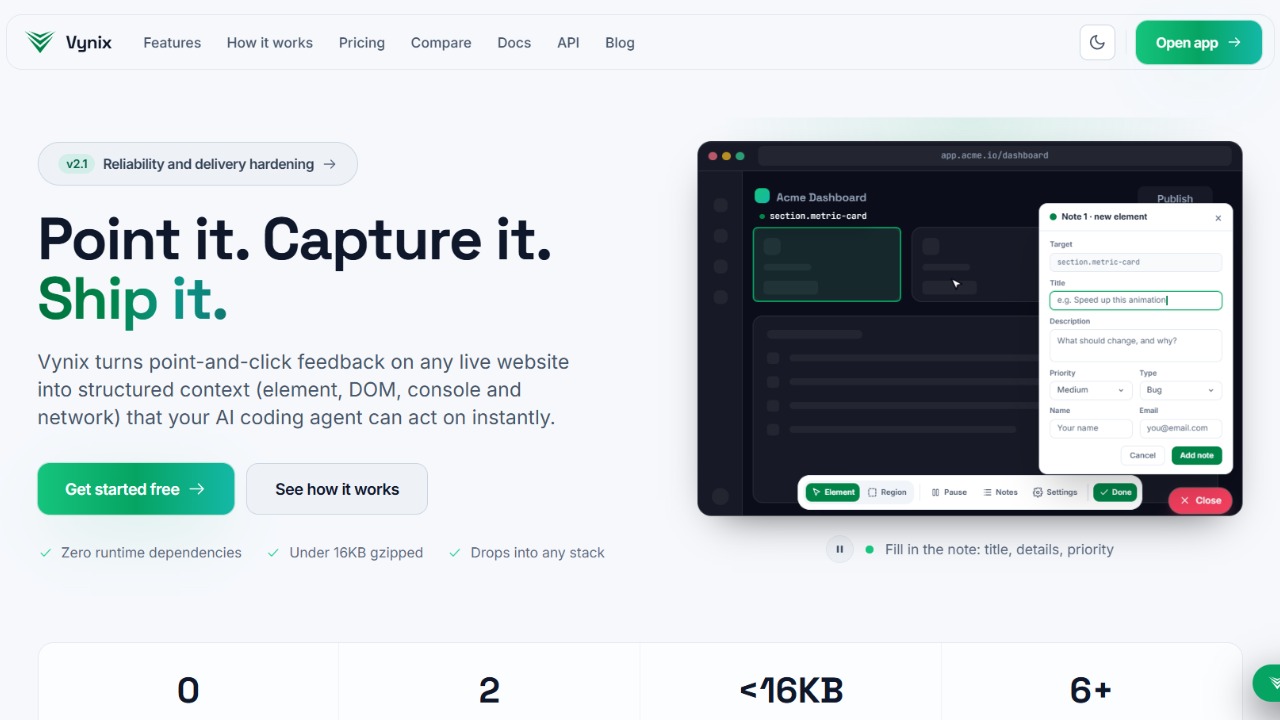
Vynix bridges the gap between user bug reports and AI coding agents with an AI-native visual annotation widget.
When a stakeholder clicks an issue on a live site, Vynix captures the exact DOM selector, browser console traces, network logs, and screenshots. It diagnoses root causes and feeds structured context directly to Claude Code and Cursor via a native MCP server.
- Native MCP Server: Delivers rich debugging context straight into your IDE.
- Automated Root-Cause Diagnosis: Evaluates console logs and DOM states to suggest code fixes.
By transforming ambiguous bug screenshots into machine-readable developer context, Vynix eliminates back-and-forth debugging cycles.
4. DocuCommit: Best Git-Native, LLM-Readable Documentation Platform
DocuCommit is a self-hosted documentation platform where every document lives as a plain Markdown file in your existing Git repository.
Because documentation remains plain text on disk with full commit history, local LLMs and MCP file servers can read, index, and update project knowledge directly without proprietary cloud APIs.
- Git-Native History: Every save is an immutable Git commit with branching and diff support.
- Agent-Readable by Default: Plain Markdown structure allows instant ingestion by coding agents.
For engineering organizations prioritizing data privacy and AI context access, DocuCommit is an outstanding solution in our Productivity Category.
5. Navlo-ai: Best Model Router and Non-Expiring API Credit Infrastructure
Navlo-ai provides intelligent multi-model routing backed by prepaid credits that never expire, replacing rigid monthly subscriptions with true usage-based flexibility.
Its routing engine inspects developer prompts in real time, routing simple queries to lightweight models and complex reasoning tasks to frontier tiers while reporting exact per-message costs.
- Intelligent Auto-Routing: Automatically selects the most cost-effective model for each prompt.
- Non-Expiring Credits: Purchased credits never lapse, preventing wasted monthly spend.
For developers seeking optimal model efficiency without subscription overhead, Navlo-ai provides an accessible routing layer in our Development Category Index.
6. SimpleData: Best Instant Web Scraping and Structured Dataset Extraction API
SimpleData converts any live website into clean, structured JSON or CSV datasets in seconds without requiring manual scraper maintenance or browser automation code.
Its smart column detection automatically identifies repeating HTML elements, product tables, and nested lists, enabling AI agents to pull fresh external web data effortlessly.
- One-Click Data Extraction: Generates structured datasets from URLs without writing code.
- Smart Pattern Detection: Automatically isolates tabular data and recurring lists.
For data analysts and AI builders requiring reliable web data ingestion, SimpleData provides instant extraction capabilities.
7. Orke: Best Desktop Workspace for Delegating Agent Terminal Tasks
Orke is a specialized desktop workspace for supervising autonomous coding agents like Claude Code and OpenAI Codex.
Instead of wrestling with detached terminal tabs, Orke provides a unified canvas combining terminal execution, live browser previews, and Git diff inspection, allowing developers to monitor agent actions within isolated containers.
- Unified Agent Canvas: Combines terminal commands, web preview, and Git diffs in one window.
- Container Isolation: Restricts agent file and network actions to safe sandbox boundaries.
Orke turns command-line agent delegation into a structured visual development control center.
8. Ecommerce Data API: Best Amazon Market and Product Intelligence API for Agents
Ecommerce Data API delivers structured Amazon product, search keyword, review, sales estimate, and trademark intelligence to AI agents and developers.
With both standard REST endpoints and a remote Model Context Protocol server, agents in Cursor or Claude Desktop can analyze market niches, monitor competitor pricing, and verify product trends interactively.
- Remote MCP Server and Skill: Connects directly into agent workflows via Model Context Protocol standards.
- Granular Marketplace Data: Provides estimated sales velocity, review histories, and keyword rankings.
For creators developing retail intelligence bots or e-commerce workflows, Ecommerce Data API offers dependable marketplace telemetry.
9. CiteRocket: Best Managed Reddit Data API for AI Builders
CiteRocket provides a managed Reddit data API designed for AI agents and market researchers seeking real-time human sentiment without OAuth complications.
Featuring 13 read endpoints and a single Bearer token, CiteRocket enables agents to query discussions, analyze subreddit trends, and monitor brand reputation with sub-second response times.
- Zero-OAuth Setup: Begin querying immediately using a single static Bearer token.
- 13 Read Endpoints: Complete coverage of posts, nested comment trees, and user histories.
For developers requiring authentic social discussions for agent research, CiteRocket provides an exceptionally streamlined API.
10. Jev TypeSafe: Best Hosted Decision API for Typed Labels and Guardrails
Jev TypeSafe provides hosted access to the Jev AI decision model, specializing in returning typed labels, probabilities, and binary validations for agent workflows.
Rather than parsing fuzzy, unstructured text outputs, engineers use Jev TypeSafe to handle intent classification, routing decisions, and safety guardrails with strict deterministic precision.
- Strictly Typed Outputs: Delivers discrete choice labels, boolean flags, and confidence scores.
- Reliable Guardrails: Bounded outputs prevent hallucinations from triggering destructive tools.
For engineers designing fault-tolerant multi-agent architectures, Jev TypeSafe delivers the deterministic guardrails modern applications require.
How We Evaluate Developer APIs and MCP Servers: The 6-Factor Originality Rubric
At AIWebsiteDirectory, we evaluate all featured tools against our established 6-Factor Originality Rubric:
- Problem-Solving Authenticity: Solves genuine developer friction beyond trivial prompt wrappers.
- Schema Determinism: Adheres strictly to OpenAPI or Model Context Protocol standards.
- Token Efficiency: Protects developer context windows through smart meta-tool routing.
- Developer Experience: Clear setup guides, maintained SDKs, and clean documentation.
- Security and Privacy: Sandboxed execution boundaries, secret protection, and zero telemetry.
- Community Maintenance: Active updates and prompt support for upstream framework changes.
This rigorous framework ensures our benchmark rankings highlight production-grade developer tooling.
Best Practices for Integrating MCP Servers into Production Agent Pipelines
When deploying Model Context Protocol servers and developer APIs in production, implement these core practices:
- Enforce Strict Tool Scoping: Restrict terminal commands to isolated containers and require explicit user confirmation for destructive actions.
- Leverage Meta-Tool Routing: Use dynamic meta-tool discovery like MCP360 when exposing more than five tools to avoid prompt saturation.
- Implement Deterministic Fallbacks: Pair probabilistic reasoning with typed validation layers like Jev TypeSafe to verify inputs before tool execution.
- Audit External Code Fixes: When delegating frontend bugfixes via Vynix or Cursor, review full Git diffs before merging.
Discover more verified tools in our Development Category Index and our AI Coding Directory.
Frequently Asked Questions
What is Model Context Protocol and why are developers adopting it?
The Model Context Protocol (MCP) is an open communication standard connecting AI assistants to external tools, databases, and environments. Before MCP, developers wrote custom API adapters for each client. MCP provides a universal specification where tools declare capabilities and schemas uniformly across Claude Code, Cursor, Windsurf, and custom agent runtimes without reconfiguration.
How do MCP servers prevent context window bloat in AI agents?
Traditional agent architectures inject every tool definition into the system prompt, consuming thousands of tokens before user input. Advanced MCP gateways like MCP360 prevent this using meta-tool indexing. Agents query available capabilities dynamically only when required, preserving context window space for code and reasoning.
What is the difference between direct REST APIs and MCP servers for AI coding?
Direct REST APIs require hardcoded client requests, manual authentication handling, and custom error parsing in code. Model Context Protocol servers wrap functionality specifically for AI agents, providing standardized machine-readable schemas and self-documenting descriptions that allow agents to inspect, invoke, and verify tools autonomously.
How can developers submit their AI tools or MCP servers to AIWebsiteDirectory?
Developers and founders building innovative AI developer tools, APIs, or Model Context Protocol servers can submit their products directly through our Submit Your AI Tool portal. Submissions undergo our 8-point verification review, functional validation, and evaluation against our 6-Factor Originality Rubric. Verified tools receive a dedicated profile and editorial rating.
