Knowledge work in 2026 has outgrown static web pages, isolated chat interfaces, and rigid to-do checklists. The modern digital workspace is fluid, fast, and increasingly autonomous. Engineers, founders, and operators manage multi-step workflows where autonomous agents execute terminal tasks, browser sessions span dozens of research tabs, and ideas require rapid empirical validation.
Yet agentic workflows introduce new operational bottlenecks. Laptops fall asleep during 40-minute Claude Code or Cursor runs, killing active processes. Browser memory bloats under research tabs while social bookmarks vanish behind algorithmic feeds. Prompt libraries remain scattered, and product ideation still relies on guesswork.
To eliminate workflow drag, the editorial team at AIWebsiteDirectory evaluated dozens of productivity tools using our 6-Factor Originality Rubric. Below are the 10 best AI browser and workflow productivity tools in 2026, ranked by tested performance, originality, and day-to-day impact.
Quick Verdict: Top Picks by Use Case
Here is our quick verdict on the top tools for specific productivity workflows:
- Best for Background Agents: Perked (Originality: 9.1/10 | Editorial: 9.2/10), prevents Mac sleep during long AI coding tasks.
- Best for Social Intelligence: Twillot (Originality: 9.1/10 | Editorial: 9.2/10), full-history X bookmark sync with AI auto-tagging and Obsidian export.
- Best for Unbiased App Discovery: FindUpApp (Originality: 8.7/10 | Editorial: 8.9/10), zero-friction directory surfacing unranked productivity tools.
- Best for Market Validation: IdeaPanda (Originality: 8.5/10 | Editorial: 8.7/10), mines consumer complaints on Reddit and forums to score business demand.
- Best for Presentations & Carousels: SupaSlides (Originality: 8.4/10 | Editorial: 8.7/10), generates slide decks and carousels with native MCP agent integration.
- Best for Spatial Collaboration: Novastart (Originality: 8.3/10 | Editorial: 8.4/10), infinite canvas whiteboard OS where humans and live AI agent cursors collaborate.
- Best for Desktop Data Feeds: Kepo (Originality: 8.2/10 | Editorial: 8.3/10), transforms RSS feeds and web monitors into shortcut widgets.
- Best for Browser Tab Organization: Tabisto (Originality: 7.8/10 | Editorial: 8.7/10), local-first AI tab clustering, RAM suspension, and visual dashboard.
- Best for Prompt Management: Save AI Prompt (Originality: 7.6/10 | Editorial: 8.2/10), browser extension prompt vault with one-click capture and refinement previews.
- Best for Calendar Focus Protection: TaskLemon (Originality: 7.6/10 | Editorial: 8.2/10), machine learning priority scheduler that protects deep focus blocks.
2026 AI Browser and Workflow Productivity Comparison Matrix
| Rank | Tool Name | Primary Focus | Originality Score | Editorial Rating | Pricing Model |
|---|---|---|---|---|---|
| 1 | Perked | Background agent keep-awake utility | 9.1 / 10 | 9.2 / 10 | €1 one-time purchase |
| 2 | Twillot | AI bookmark vault and Markdown export | 9.1 / 10 | 9.2 / 10 | Freemium / Pro tiers |
| 3 | FindUpApp | Zero-friction niche software discovery | 8.7 / 10 | 8.9 / 10 | 100% Free / No sign-up |
| 4 | IdeaPanda | Market validation from forum feedback | 8.5 / 10 | 8.7 / 10 | Lifetime / One-time payment |
| 5 | SupaSlides | Slide and carousel generator with MCP | 8.4 / 10 | 8.7 / 10 | Freemium / Subscription |
| 6 | Novastart | Infinite spatial whiteboard with AI cursors | 8.3 / 10 | 8.4 / 10 | Freemium / Team plans |
| 7 | Kepo | Desktop widgets for feeds and metrics | 8.2 / 10 | 8.3 / 10 | Freemium / Free tier |
| 8 | Tabisto | Local tab grouping and RAM suspension | 7.8 / 10 | 8.7 / 10 | Free Chrome extension |
| 9 | Save AI Prompt | Browser prompt vault with live preview | 7.6 / 10 | 8.2 / 10 | Free / Community library |
| 10 | TaskLemon | ML task scheduling and focus shield | 7.6 / 10 | 8.2 / 10 | Freemium / SaaS |
Detailed Reviews: The 10 Best AI Workflow and Browser Tools
1. Perked: Background Agent Keep-Awake Utility
Autonomous coding agents like Claude Code, Cursor, and Aider often execute long refactoring tasks taking 30 to 60 minutes. Standard operating system sleep disrupts these jobs: closing a laptop lid suspends processes, kills API streams, and corrupts partial file writes.
Perked prevents this from the macOS menu bar. Unlike generic keep-awake utilities, Perked monitors active AI agents and prevents sleep only during execution. It supports clamshell mode safely and releases power locks when tasks finish. Evaluated under our 6-Factor Originality Rubric, Perked scored 9.1 / 10 in originality and 9.2 / 10 in editorial rating in our Productivity directory.
- Primary Strength: Process-specific agent monitoring with automatic power lock release.
- Pricing Model: €1 one-time purchase with no recurring fees.
- Directory Profile: Explore Perked on AIWebsiteDirectory
2. Twillot: AI Bookmark Vault and Knowledge Archive
X (formerly Twitter) is where researchers, developers, and founders share technical breakthroughs and code snippets. However, native bookmarks suffer from strict scroll caps, zero organization, and permanent loss when posts are removed.
Twillot synchronizes your complete bookmark history into an offline, searchable knowledge vault. Its natural language engine organizes posts into topic folders, extracts media, and indexes commentary for quick retrieval. For documentation workflows, Twillot exports cleanly to Markdown, Obsidian vaults, CSV, and PDF formats. Scoring 9.1 / 10 in originality and 9.2 / 10 in editorial review, Twillot is an essential archive for knowledge curators.
- Primary Strength: Full bookmark history synchronization with offline search and Obsidian export.
- Pricing Model: Freemium model with Pro upgrades.
- Directory Profile: Explore Twillot on AIWebsiteDirectory
3. FindUpApp: Zero-Barrier AI Software Discovery Engine
Commercial mobile app stores favor high-budget corporations, burying niche productivity tools, terminal utilities, and indie web apps under shallow search taxonomies.
FindUpApp provides an open discovery directory without gatekeeping. The platform requires no sign-up, passwords, or listing fees. Submit any URL, and FindUpApp's autonomous AI crawler fetches metadata, screenshots, and feature highlights to generate concise editorial summaries. Deep hierarchical categorization and multilingual support help builders gain organic traction. FindUpApp earned an 8.7 / 10 originality score and 8.9 / 10 editorial rating for democratizing software discovery.
- Primary Strength: Frictionless app indexing with AI-automated metadata extraction.
- Pricing Model: 100% Free with open community contributions.
- Directory Profile: Explore FindUpApp on AIWebsiteDirectory
4. IdeaPanda: Market-Validated Ideation and Demand Scorer
Most startups fail by building products without verified customer demand. Standard generative chatbots frequently suggest generic concepts disconnected from actual consumer willingness to pay.
IdeaPanda grounds ideation in empirical user frustration. It continuously scans Reddit communities, app reviews, and forums to identify recurring complaints and bottlenecks. Each opportunity is scored out of 100 across market demand, competitive density, and buildability. Founders receive dossiers detailing target audiences, competitor weaknesses, and monetization models. With a transparent one-time purchase model, IdeaPanda earned an 8.5 / 10 originality rating as a pre-build validation engine.
- Primary Strength: Quantitative idea validation derived from live consumer friction.
- Pricing Model: One-time payment for lifetime platform access.
- Directory Profile: Explore IdeaPanda on AIWebsiteDirectory
5. SupaSlides: Slide Deck and Carousel Generator with MCP Control
Creating pitch decks and social carousels consumes hours of manual formatting. Founders and operators frequently spend valuable time adjusting layouts rather than focusing on core messaging.
SupaSlides transforms raw text, markdown documents, and website URLs into structured slide decks and animated carousels in seconds. Its defining advantage is native support for the Model Context Protocol (MCP). By exposing standardized MCP endpoints, SupaSlides enables autonomous agents to generate and update slide decks programmatically from terminal commands. Backed by an 8.4 / 10 originality score and 8.7 / 10 editorial rating, it bridges automated agent output with visual communication.
- Primary Strength: Automated slide generation with native Model Context Protocol (MCP) controls.
- Pricing Model: Freemium model with monthly Pro subscription plans.
- Directory Profile: Explore SupaSlides on AIWebsiteDirectory
6. Novastart: Infinite Canvas Whiteboard OS for Teams and Agents
Toggling between separate browser windows, code editors, spreadsheet tables, and chat assistants fractures cognitive focus and slows team execution.
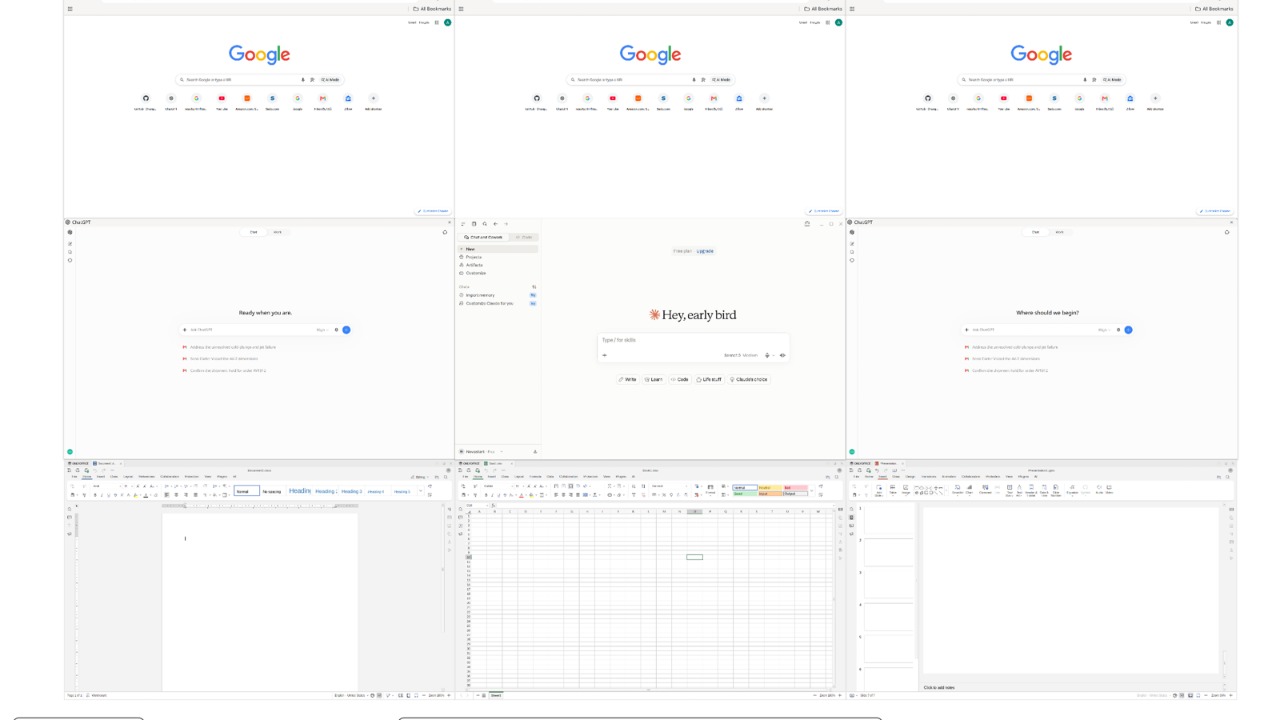
Novastart reimagines digital workspaces as an infinite spatial whiteboard. Users run live instances of Chrome, ChatGPT, Claude, Word, and Excel side-by-side on an expansive canvas. Its standout innovation is integrating AI agents as first-class canvas participants with visible cursors and virtual keyboards, collaborating alongside human teammates in real time. Teammates can watch agent progress, intervene mid-task, and review shared assets spatially. Scoring 8.3 / 10 in originality, Novastart delivers a pioneering workspace for human-agent teams.
- Primary Strength: Spatial canvas hosting live apps and collaborative AI agent cursors.
- Pricing Model: Freemium tier with multi-seat team workspace options.
- Directory Profile: Explore Novastart on AIWebsiteDirectory
7. Kepo: AI-Powered Mac Desktop Widget and Dashboard Hub
Keeping dozens of browser tabs open to track market tickers, RSS feeds, server metrics, or competitor news consumes RAM and creates constant distraction.
Kepo converts arbitrary web feeds and live data streams into compact macOS desktop widgets accessible via a global shortcut. Users inspect real-time metrics instantly and dismiss the panel without losing focus. Kepo features a natural language widget builder, allowing users to describe the monitor they need while the AI configures parsing automatically. With an 8.2 / 10 originality score and 8.3 / 10 editorial rating, Kepo reduces tab clutter while keeping critical signals accessible.
- Primary Strength: Shortcut-summoned desktop widgets created through natural language AI descriptions.
- Pricing Model: Freemium tier with free core widgets and Pro custom integrations.
- Directory Profile: Explore Kepo on AIWebsiteDirectory
8. Tabisto: Local-First AI Browser Tab Manager and Dashboard
When research sessions balloon to dozens of open tabs, browser performance drops and finding specific pages becomes frustrating. Traditional bookmark managers fail because manual tagging is abandoned during rapid workflows.
Tabisto re-engineers tab management with an AI Chrome extension that prioritizes local-first privacy. It semantically analyzes open page content in real time, automatically organizing tabs into named topic clusters. Inactive tabs are suspended to free up memory without losing state or scroll position. Tabisto also replaces the new-tab page with an offline visual workspace with saved sessions and quick search. Earning an 8.7 / 10 editorial rating, it brings calm efficiency to browser workflows.
- Primary Strength: Local-first semantic tab clustering, memory suspension, and visual dashboard.
- Pricing Model: Free Chrome extension with full productivity features.
- Directory Profile: Explore Tabisto on AIWebsiteDirectory
9. Save AI Prompt: Browser Prompt Vault and Evolution Preview
System prompts and engineering instructions are high-value digital assets, yet professionals frequently lose them in messy text files or ephemeral chat logs.
Save AI Prompt provides a browser extension that captures prompts with one click inside ChatGPT, Claude, Gemini, and Midjourney. Saved templates are categorized with tags and synced to an encrypted cloud vault for quick keyboard insertion. A unique feature is its live prompt evolution preview, which illustrates how semantic adjustments sharpen output clarity. Scoring 7.6 / 10 in originality and 8.2 / 10 in editorial review, Save AI Prompt standardizes effective prompt libraries across workflows.
- Primary Strength: One-click in-chat prompt saving with live semantic refinement previews.
- Pricing Model: Free platform with community prompt repository access.
- Directory Profile: Explore Save AI Prompt on AIWebsiteDirectory
10. TaskLemon: Adaptive ML Priority Scheduler and Focus Shield
Conventional to-do lists rely on manual deadline estimation, which frequently breaks down when unforeseen urgent tasks disrupt the workday.
TaskLemon applies machine learning algorithms to automate task scheduling and workload balancing. By analyzing historical completion speeds and project complexity, TaskLemon suggests realistic deadlines while integrating directly with Google Calendar, Slack, and Trello. Crucially, its proactive focus shield identifies impending bottlenecks and reserves deep-work blocks on your calendar to prevent overcommitment. Awarded an 8.2 / 10 editorial rating, TaskLemon transforms passive checklists into an intelligent productivity co-pilot.
- Primary Strength: Machine learning deadline estimation with automated calendar focus protection.
- Pricing Model: Freemium model with Pro productivity upgrades for power users.
- Directory Profile: Explore TaskLemon on AIWebsiteDirectory
How to Build a Modern AI Productivity Stack in 2026
Constructing an effective productivity stack requires choosing specialized tools that eliminate specific friction points across your workflow loop:
- Background Execution: Pair autonomous agents with Perked to guarantee long coding sessions complete without system sleep interruptions.
- Information & Tab Organization: Use Tabisto to prevent browser memory bloat and Twillot to preserve permanent technical research from social feeds.
- Prompt Engineering & Discovery: Store refined model instructions in Save AI Prompt and discover unranked software tools through FindUpApp.
- Ideation & Execution: Validate market demand using IdeaPanda before building, and use SupaSlides and Novastart for spatial team execution.
Builders creating innovative productivity software can submit their products for benchmark evaluation on our Product Submission Portal. Discover hundreds of curated software tools in our Productivity Directory.
Frequently Asked Questions
How do AI browser extensions protect user data privacy?
Leading productivity extensions like Tabisto and Save AI Prompt utilize local-first architectures. Rather than transmitting webpage contents or chat histories to cloud servers, semantic clustering routines run directly in your browser using client-side JavaScript and local storage APIs. When cloud sync is utilized, metadata is encrypted in transit and at rest.
Why do autonomous coding agents need dedicated keep-awake utilities like Perked?
Autonomous coding agents like Claude Code, Cursor background refactor, and Aider execute multi-file refactoring and testing tasks that last 30 minutes or more. Standard operating systems trigger sleep after brief inactivity, severing terminal sessions and corrupting files. Dedicated utilities monitor active agent processes to keep hardware awake until tasks finish.
What is the difference between an AI tab manager and standard Chrome tab groups?
Standard Chrome tab groups require manual labeling, dragging, and maintenance. In contrast, AI tab managers like Tabisto analyze webpage text and metadata automatically, clustering related research tabs into contextual workspaces without manual input while suspending background tabs to reclaim gigabytes of system memory.
Can indie builders get their productivity tools benchmarked on AIWebsiteDirectory?
Yes, indie developers and engineering teams can submit their software directly through the AIWebsiteDirectory platform via the public submission form. Submitted applications undergo evaluation using our 6-Factor Originality Rubric, assessing functional differentiation, technical sophistication, and real-world utility for potential inclusion in our benchmark guides.
