
The tech industry moved at breakneck speed this week, with artificial intelligence at the center of nearly every major story. From explosive legal battles over trade secrets to new frontier model releases and record-breaking IPOs in the semiconductor space, the themes were clear: intense competition, massive capital deployment, and growing regulatory and IP tensions.
Here’s a clear-eyed roundup of the biggest developments from July 7 - 13, 2026.
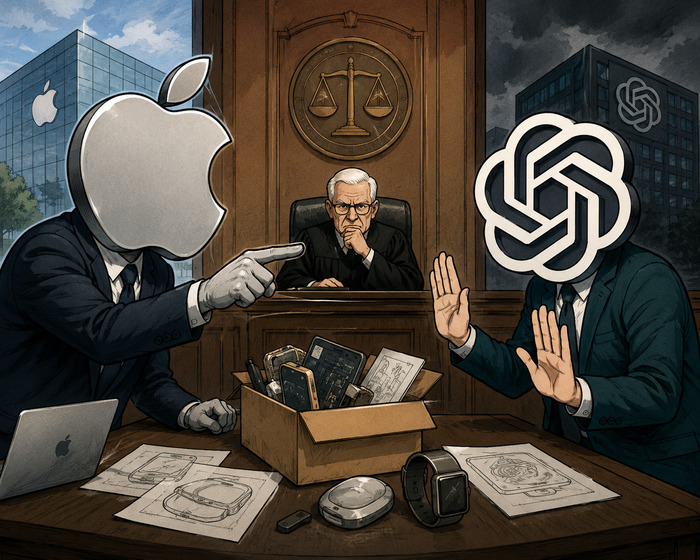
1. Apple Sues OpenAI Over Alleged Trade Secret Theft for Hardware Ambitions
In one of the week’s most dramatic stories, Apple filed a lawsuit against OpenAI, its hardware-focused subsidiary io Products (the Jony Ive-backed company OpenAI acquired), and two former Apple executives.
Apple alleges a coordinated campaign to steal confidential information about unreleased products, manufacturing processes, supplier details, and hardware designs. The complaint claims OpenAI has hired more than 400 former Apple employees and that its leadership, including Chief Hardware Officer Tang Yew Tan (former Apple VP of Product Design), actively solicited trade secrets during recruiting.
Specific allegations include:
- Job candidates being asked to bring actual Apple hardware parts to interviews.
- Coaching departing employees on evading Apple’s security protocols.
- One former engineer allegedly downloading dozens of confidential files after leaving the company.
Apple is seeking to stop OpenAI from using the allegedly stolen information and demanding the return of any materials. OpenAI has denied the claims, stating it has “no interest in other companies’ trade secrets.”
This lawsuit highlights the high stakes as OpenAI pushes into consumer hardware while Apple defends its long-standing hardware advantages. It also underscores the broader talent war in AI, where companies are aggressively recruiting from each other.
2. Meta Launches Muse Spark 1.1 and Enters the Paid AI Model Arena
Meta made a significant move this week with the launch of Muse Spark 1.1, its upgraded multimodal reasoning model from the Superintelligence Labs. The model focuses on agentic tasks, coding, tool use, computer use, and multi-agent orchestration, with a massive 1-million-token context window.
Key highlights:
- Strong performance claims in coding and complex multi-step tasks.
- Available in “Thinking” mode in the Meta AI app.
- Public preview of the Meta Model API, Meta’s first broad developer access to one of its frontier models, with pay-as-you-go pricing positioned competitively.
- Mark Zuckerberg personally announced it on X (his first post there in over three years).
Meta also rolled out Muse Image with new verification features (Content Seal watermarking). However, the launch sparked controversy and some reports of feature adjustments over concerns about using public Instagram photos for AI training and potential deepfake misuse.
This marks Meta’s clearest step yet into monetizing its AI capabilities directly while keeping consumer access broadly available. It positions the company as a more aggressive competitor to OpenAI and Anthropic in the developer and enterprise segments.

3. OpenAI Rolls Out GPT-5.6 Family Publicly
After weeks of limited previews and U.S. government review (focused on cybersecurity and safety), OpenAI made its GPT-5.6 family (including Sol, Terra, and Luna variants) publicly available.
The release follows a pattern of staggered or controlled rollouts for the most advanced models. Early reports highlighted strong performance in reasoning and complex tasks, with some claims of advanced mathematical capabilities surfacing in coverage.
The launch reinforces OpenAI’s position at the frontier while highlighting ongoing government scrutiny of the most powerful AI systems.
4. SK Hynix’s Record-Breaking U.S. IPO and the AI Memory Boom
The semiconductor sector had a standout week with SK Hynix completing a massive U.S. IPO, raising approximately $26.5 billion. The South Korean memory chip giant saw strong investor interest driven by surging demand for high-bandwidth memory (HBM) used in AI training and inference.
This comes amid broader strength in the memory sector:
- Samsung reported record quarterly profits fueled by AI chip demand (though shares faced some investor concerns over capex).
- Micron and others continue to benefit from the AI infrastructure buildout.
The IPO underscores how AI is reshaping capital markets and supply chains in semiconductors, with memory becoming as critical as GPUs in the AI stack.
5. Microsoft’s Gaming Overhaul and Layoffs
Microsoft announced significant workforce reductions (reports ranged from ~3,200 to 4,800 roles), primarily affecting the Xbox division and sales teams. The moves come as the company reevaluates its Game Pass strategy and gaming investments after years of heavy spending.
This reflects a broader pattern of Big Tech recalibrating amid enormous AI-related capital expenditures while trying to improve efficiency in non-core or underperforming areas.
6. Apple Secures Major U.S. Chip Manufacturing Deal
In positive news for domestic semiconductor production, Apple expanded its partnership with Broadcom in a multi-year agreement reportedly exceeding $30 billion. The deal supports production of custom silicon and wireless components in the U.S., with Broadcom investing in facilities (including in Colorado).
This aligns with ongoing efforts to strengthen U.S. chip manufacturing capabilities.
Other Notable Mentions
- Energy and Infrastructure: Continued massive capex by hyperscalers. Google and others backed fusion energy startups. Concerns grew about AI data centers’ power consumption (projections suggest AI servers could surpass conventional data center hardware in power use by 2027).
- Regulation & Governance: The FTC began enforcing the TAKE IT DOWN Act (nonconsensual intimate imagery). The UN released its first global independent scientific assessment on AI opportunities, risks, and impacts. Various privacy and surveillance debates continued in the EU and U.S.
- Robotics & Embodied AI: Reports of advances in humanoid robots performing surgical tasks (teleoperated) and Chinese labs pushing physical AI models.
What This Week Tells Us About the State of Tech
This week crystallized several trends shaping 2026 tech:
- AI competition is now multidimensional - not just model performance, but agentic capabilities, pricing, developer ecosystems, and hardware integration.
- IP and talent wars are escalating - as the stakes rise, so do legal battles over what constitutes legitimate competition vs. misappropriation.
- Infrastructure is the new battleground - chips, power, data centers, and energy are as strategically important as the models themselves.
- Monetization pressure is real - even companies that long gave AI away for free (or cheap) are introducing paid tiers and APIs.
The pace shows no signs of slowing. Next week will likely bring more model updates, earnings-related commentary, and further developments in the Apple-OpenAI legal saga.
What do you think will be the biggest story of the next few weeks? More legal fireworks, a breakthrough in efficient models, or something in energy/infrastructure? Let me know in the comments.
This roundup is based on reporting from Reuters, TechCrunch, The Verge, NYT, Financial Times, and other major outlets as of July 13, 2026.
